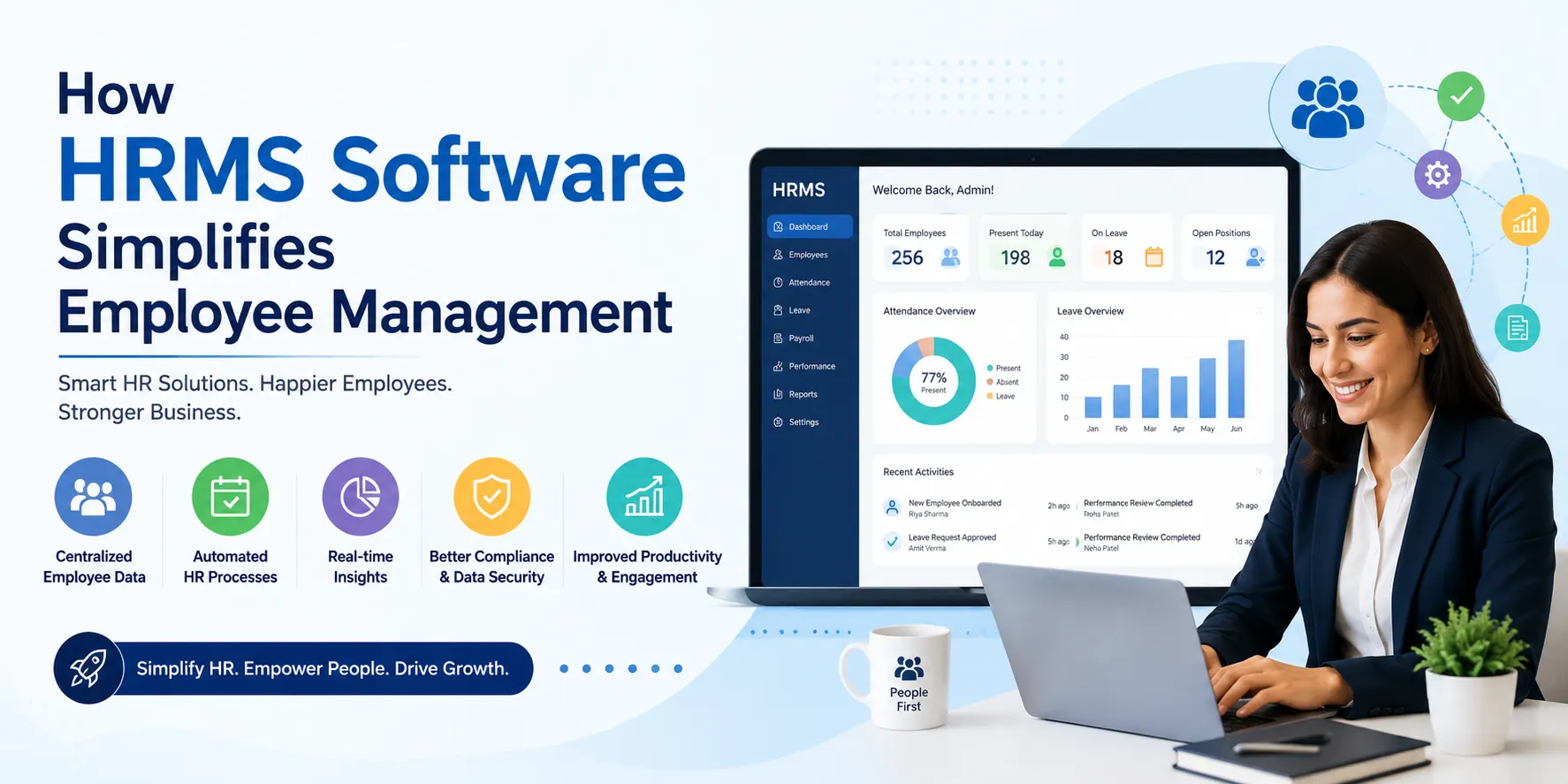
Employee management has become more complex than ever. As businesses grow, managing attendance, payroll, leave requests, employee records, performance, compliance, and communication manually can consume valuable time and increase the risk of errors.
This is where HRMS Software transforms the way organizations operate. A modern Human Resource Management System (HRMS) automates repetitive HR tasks, centralizes employee information, improves compliance, and enhances the overall employee experience.
Whether you’re a startup, SME, or large enterprise, investing in the Best HRMS Software helps streamline HR operations while enabling your HR team to focus on strategic initiatives rather than administrative work.
In this guide, we’ll explore how HRMS software simplifies employee management, its core features, benefits, implementation tips, and why businesses are rapidly adopting intelligent HR Solutions.
What is HRMS Software?
HRMS Software (Human Resource Management System) is a comprehensive digital platform that automates and manages every stage of the employee lifecycle—from recruitment and onboarding to payroll, attendance, performance management, compliance, and employee exit processes.
Instead of using multiple spreadsheets and disconnected systems, businesses can manage everything through a single centralized platform.
Modern HRMS platforms also leverage AI, cloud computing, workflow automation, and analytics to help organizations make smarter workforce decisions.
Why Businesses Need HRMS Software Today
Today’s workforce expects speed, transparency, and flexibility.
HR professionals, on the other hand, need tools that reduce manual work while ensuring legal compliance.
Without an HRMS, companies often struggle with:
- Manual attendance tracking
- Payroll calculation errors
- Lost employee records
- Compliance challenges
- Delayed approvals
- Difficult performance reviews
- Poor employee communication
- Time-consuming HR processes
A robust HRMS Software solves these challenges through automation and centralized management.
How HRMS Software Simplifies Employee Management
1. Centralized Employee Database
One of the biggest advantages of HRMS Software is maintaining all employee information in one secure location.
This includes:
- Personal details
- Employment history
- Salary information
- Tax documents
- Performance records
- Attendance history
- Leave balances
- Certifications
- Important documents
Instead of searching through files or spreadsheets, HR teams can instantly access employee data whenever needed.
2. Automated Attendance Management
Tracking attendance manually often leads to inaccuracies.
Modern HRMS systems integrate with:
- Biometric devices
- Mobile attendance
- GPS attendance
- Face recognition
- Web check-in systems
Employees can clock in easily while HR receives accurate attendance reports automatically.
Benefits include:
- Reduced payroll disputes
- Real-time attendance monitoring
- Shift management
- Overtime tracking
- Late arrival reports
3. Simplified Leave Management
Managing employee leave manually is frustrating for both HR and employees.
HRMS Software automates:
- Leave applications
- Multi-level approvals
- Leave balance calculation
- Holiday calendars
- Comp-off management
- Leave policies
Employees can apply online, managers approve instantly, and leave balances update automatically.
4. Error-Free Payroll Processing
Payroll is one of the most critical HR responsibilities.
Manual payroll processing often results in:
- Salary errors
- Tax mistakes
- Delayed payments
- Compliance issues
The Best HRMS Software automates payroll calculations based on:
- Attendance
- Leaves
- Overtime
- Bonuses
- Incentives
- Deductions
- Taxes
This significantly reduces human errors while ensuring employees are paid accurately and on time.
5. Faster Employee Onboarding
First impressions matter.
HRMS simplifies onboarding through digital workflows.
New employees can:
- Upload documents
- Complete forms
- Sign policies digitally
- Receive welcome emails
- Access training materials
HR no longer needs to collect paperwork manually.
A structured onboarding process also improves employee engagement from day one.
6. Better Performance Management
Traditional annual performance reviews are slowly disappearing.
Modern HRMS Software supports continuous performance management through:
- Goal tracking
- KPI management
- Performance reviews
- Employee feedback
- Self-assessments
- Manager evaluations
This creates a transparent and measurable performance culture.
7. Employee Self-Service Portal
One of the most appreciated HRMS features is Employee Self-Service (ESS).
Employees can independently:
- Download salary slips
- Update profiles
- Apply for leave
- Check attendance
- View tax documents
- Download certificates
- Track reimbursements
- Access company policies
This reduces HR workload while improving employee satisfaction.
8. Improved HR Compliance
Labour laws and statutory compliance continue evolving.
An HRMS helps organizations comply with regulations by automating:
- Employee documentation
- Payroll compliance
- Tax calculations
- Leave policies
- Audit records
- Compliance reports
Businesses can minimize legal risks while maintaining accurate documentation.
9. Workforce Analytics and Reporting
Modern businesses rely on data-driven decisions.
HRMS dashboards provide insights such as:
- Employee turnover
- Attendance trends
- Department productivity
- Leave statistics
- Payroll expenses
- Hiring metrics
- Performance analytics
These reports help HR leaders identify opportunities for workforce optimization.
10. Secure Employee Data Management
Employee information contains sensitive data.
The Best HRMS Software includes:
- Role-based access
- Data encryption
- Secure cloud storage
- Audit logs
- Automated backups
- Multi-factor authentication
This ensures confidential employee information remains protected.
Key Features to Look for in the Best HRMS Software
When selecting HRMS Software, businesses should prioritize features that support both current and future workforce needs.
Essential features include:
- Employee database management
- Attendance management
- Leave management
- Payroll automation
- Employee self-service portal
- Recruitment management
- Onboarding automation
- Performance management
- Expense management
- Document management
- Mobile application
- Analytics dashboard
- Compliance management
- Shift scheduling
- Workflow automation
- AI-powered reporting
- Cloud accessibility
- Multi-location support
Benefits of Implementing HRMS Software
Organizations implementing HRMS Software experience measurable improvements across HR operations.
Increased Productivity
Automation reduces repetitive administrative tasks, allowing HR professionals to focus on strategic initiatives.
Reduced Operational Costs
Less paperwork, fewer manual processes, and improved efficiency lower overall HR costs.
Better Employee Experience
Employees gain faster access to HR services through self-service features.
Improved Decision-Making
Real-time analytics help management make informed workforce decisions.
Higher Accuracy
Automation minimizes errors in attendance, payroll, leave, and employee records.
Faster HR Processes
Approvals, document verification, onboarding, and payroll processing become significantly faster.
Business Scalability
As organizations grow, HRMS scales seamlessly without increasing administrative complexity.
Industries That Benefit from HRMS Software
Almost every industry can leverage HR automation.
Popular sectors include:
- IT Companies
- Healthcare
- Manufacturing
- Retail
- Logistics
- Education
- Construction
- Banking
- Hospitality
- Real Estate
- E-commerce
- Government Organizations
- Consulting Firms
Regardless of industry, HRMS simplifies workforce management.
How AI is Transforming Modern HRMS Software
Artificial Intelligence is redefining HR operations.
AI-powered HRMS platforms now offer:
- Resume screening
- Candidate matching
- Predictive workforce analytics
- Employee sentiment analysis
- AI chatbots
- Smart attendance monitoring
- Automated HR support
- Performance predictions
- Intelligent reporting
These innovations help HR teams make faster and smarter decisions while enhancing employee engagement.
Tips for Choosing the Best HRMS Software
Before investing, evaluate your business requirements carefully.
Consider:
- Business size
- Industry-specific requirements
- Payroll complexity
- Compliance needs
- Mobile accessibility
- Cloud availability
- Integration capabilities
- User-friendly interface
- Customer support
- Data security
- Customization options
- Future scalability
Choosing the Best HRMS Software ensures long-term efficiency and business growth.
Why Integrated HR Solutions Matter
Modern organizations require more than payroll software.
Comprehensive HR Solutions combine recruitment, attendance, payroll, performance management, employee engagement, analytics, and compliance into one unified platform.
Instead of switching between multiple applications, HR teams can manage the complete employee lifecycle from a single dashboard.
This improves operational efficiency, data accuracy, collaboration, and overall employee satisfaction.
Conclusion
Managing employees manually is no longer sustainable for growing businesses. Increasing workforce complexity, changing compliance requirements, and rising employee expectations demand smarter and more efficient HR processes.
Implementing HRMS Software enables businesses to automate routine tasks, improve payroll accuracy, streamline attendance and leave management, strengthen compliance, and enhance the employee experience. From onboarding to performance management and workforce analytics, an HRMS supports every stage of the employee lifecycle while saving time and reducing operational costs.
If your organization is looking to improve productivity, reduce administrative burden, and build a future-ready workplace, investing in the Best HRMS Software is a strategic decision. Combined with modern HR Solutions, it empowers HR teams to focus on people, culture, and business growth instead of repetitive manual processes.
As businesses continue embracing digital transformation, adopting a scalable HRMS platform is no longer just an advantage, it’s an essential step toward creating a more agile, efficient, and employee-centric organization.
FAQs
1. What is HRMS Software, and how does it simplify employee management?
HRMS Software is a digital platform that automates HR processes such as attendance, payroll, leave management, onboarding, performance tracking, and employee record management. It reduces manual work, improves accuracy, and helps HR teams manage employees more efficiently.
2. What features should businesses look for in the Best HRMS Software?
The Best HRMS Software should include payroll management, attendance tracking, leave management, employee self-service, recruitment, onboarding, performance management, analytics, compliance management, workflow automation, mobile access, and cloud-based security.
3. Can HRMS Software integrate with payroll, biometric devices, and third-party business applications?
Yes. Most modern HRMS platforms support seamless integration with payroll systems, biometric attendance machines, accounting software, ERP solutions, CRM platforms, Google Workspace, Microsoft 365, and various third-party APIs for streamlined business operations.
4. Is HRMS Software suitable for small businesses and startups?
Absolutely. HRMS Software is designed for businesses of all sizes. Startups and SMEs can automate HR operations, reduce administrative costs, improve compliance, and scale their workforce management efficiently as the company grows.
5. How do modern HR Solutions improve employee productivity and business growth?
Modern HR Solutions automate repetitive HR tasks, provide real-time workforce insights, improve communication, enhance employee engagement, ensure regulatory compliance, and enable data-driven decision-making. This leads to higher productivity, better employee satisfaction, and sustainable business growth.