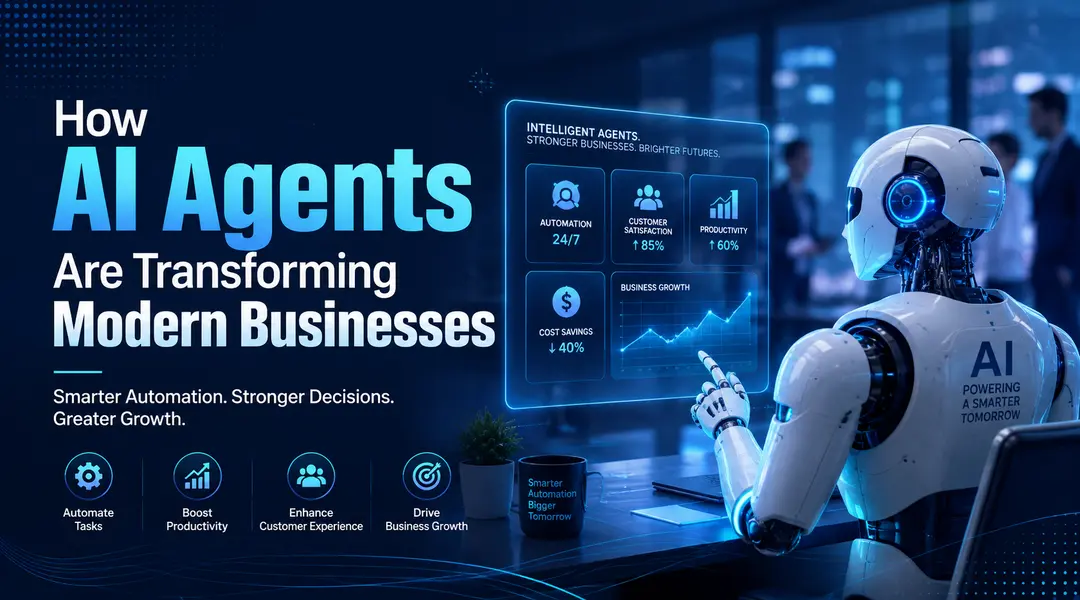
Artificial Intelligence (AI) has evolved far beyond chatbots and predictive analytics. Today, AI agents are becoming one of the most powerful technologies for business automation, decision-making, and customer engagement. Organizations of all sizes are adopting AI agents to streamline operations, improve customer experiences, reduce costs, and increase productivity.
Unlike traditional software, AI agents can understand tasks, make decisions, learn from interactions, and complete complex workflows with minimal human intervention. As businesses continue their digital transformation journey, AI agents are helping them stay competitive in an increasingly data-driven world.
In this guide, we’ll explore what AI agents are, how they work, their benefits, real-world applications, future trends, and why investing in AI agent development can be a game-changer for modern businesses.
What Are AI Agents?
An AI agent is an intelligent software system capable of perceiving information, analyzing data, making decisions, and performing tasks autonomously to achieve specific goals.
Unlike conventional automation tools that follow predefined rules, AI agents can:
- Learn from historical data
- Understand user intent
- Adapt to changing conditions
- Interact naturally with humans
- Work independently or collaborate with other AI systems
AI agents leverage technologies such as:
- Machine Learning (ML)
- Natural Language Processing (NLP)
- Large Language Models (LLMs)
- Computer Vision
- Predictive Analytics
- Reinforcement Learning
These technologies enable AI agents to solve problems, automate workflows, and continuously improve over time.
How Do AI Agents Work?
AI agents typically operate through four key stages:
1. Data Collection
The AI agent gathers information from various sources, including:
- Business software
- Customer interactions
- Emails
- Documents
- APIs
- IoT devices
- CRM and ERP systems
2. Understanding Context
Using Natural Language Processing and machine learning, the AI agent interprets the collected data and understands the task or objective.
3. Decision-Making
The agent evaluates available options, predicts outcomes, and selects the most appropriate action based on business goals.
4. Continuous Learning
Every interaction helps improve future performance. AI agents learn from feedback, making them increasingly accurate and efficient over time.
Why Modern Businesses Are Investing in AI Agents
Businesses across industries are embracing AI agents because they solve real operational challenges.
Some key reasons include:
- Rising customer expectations
- Growing operational complexity
- Labor shortages
- Increased competition
- Need for faster decision-making
- Cost optimization
- Digital transformation initiatives
AI agents help organizations address these challenges while improving overall business performance.
Top Benefits of AI Agents for Businesses
1. Automating Repetitive Tasks
AI agents eliminate repetitive manual work such as:
- Data entry
- Appointment scheduling
- Email responses
- Invoice processing
- Document management
- Report generation
This allows employees to focus on strategic and creative work.
2. 24/7 Customer Support
AI-powered virtual agents can assist customers around the clock by:
- Answering FAQs
- Resolving common issues
- Tracking orders
- Booking appointments
- Providing product recommendations
This improves customer satisfaction while reducing support costs.
3. Faster Decision-Making
AI agents analyze massive amounts of business data within seconds.
They help leaders:
- Forecast demand
- Detect business risks
- Identify market trends
- Monitor performance
- Recommend optimal actions
This enables smarter and faster business decisions.
4. Increased Employee Productivity
Instead of replacing employees, AI agents work alongside them.
Employees spend less time on administrative tasks and more time on:
- Innovation
- Customer relationships
- Sales
- Business strategy
- Problem-solving
5. Improved Customer Experience
AI agents personalize every interaction by understanding customer preferences and behavior.
Examples include:
- Personalized product recommendations
- Faster responses
- Intelligent customer journeys
- Tailored marketing campaigns
6. Reduced Operational Costs
Businesses can significantly reduce expenses by automating repetitive workflows.
Savings often come from:
- Lower staffing costs
- Fewer manual errors
- Faster processes
- Better resource allocation
7. Better Business Intelligence
AI agents continuously monitor business performance and provide actionable insights.
Examples include:
- Sales trends
- Customer behavior
- Inventory optimization
- Marketing performance
- Financial forecasting
Real-World AI Agent Use Cases
Customer Service
AI agents answer customer queries instantly, reducing wait times while improving support quality.
Examples:
- Live chat
- Help desk automation
- Ticket routing
- Customer onboarding
Sales Automation
Sales teams use AI agents to:
- Qualify leads
- Schedule meetings
- Follow up with prospects
- Generate sales reports
- Predict customer purchases
Marketing
Marketing teams leverage AI agents for:
- Content creation
- Email marketing
- Campaign optimization
- Audience segmentation
- Social media management
Human Resources
HR departments automate:
- Resume screening
- Candidate communication
- Employee onboarding
- Attendance tracking
- Performance evaluations
Finance
Financial institutions use AI agents for:
- Fraud detection
- Risk analysis
- Invoice processing
- Budget forecasting
- Expense management
Healthcare
Healthcare providers utilize AI agents for:
- Appointment scheduling
- Patient support
- Medical documentation
- Treatment recommendations
- Remote monitoring
Manufacturing
Manufacturers improve efficiency through:
- Predictive maintenance
- Inventory management
- Production scheduling
- Quality inspections
- Supply chain optimization
E-commerce
Online retailers use AI agents for:
- Personalized shopping
- Order tracking
- Inventory forecasting
- Customer support
- Dynamic pricing
AI Agents vs Traditional Business Automation
| AI Agents | Traditional Automation |
| Learn continuously | Rule-based |
| Understand language | Fixed workflows |
| Adapt to changes | Limited flexibility |
| Make intelligent decisions | Predefined logic |
| Improve over time | Manual updates required |
This adaptability makes AI agents far more valuable for dynamic business environments.
Industries Benefiting Most from AI Agents
Almost every industry is experiencing the impact of AI agents, including:
- Healthcare
- Banking
- Insurance
- Retail
- Manufacturing
- Logistics
- Education
- Real Estate
- Travel
- Hospitality
- SaaS
- Information Technology
Challenges Businesses Should Consider
While AI agents offer significant advantages, successful implementation requires careful planning.
Key considerations include:
- Data privacy and security
- Integration with existing systems
- Employee training
- Regulatory compliance
- AI governance
- Continuous monitoring
- High-quality data
Addressing these factors helps businesses maximize the value of AI agent deployments.
Future Trends of AI Agents
The next generation of AI agents will become even more autonomous and collaborative.
Emerging trends include:
- Multi-agent collaboration
- Autonomous business operations
- AI-powered digital employees
- Hyper-personalized customer experiences
- Industry-specific AI agents
- Voice-first business assistants
- Edge AI integration
- AI agents integrated into enterprise software
As these technologies mature, AI agents will become essential tools for organizations seeking sustainable growth.
How to Choose the Right AI Agent Development Partner
When selecting an AI development company, consider:
- Experience with AI and machine learning
- Expertise in NLP and LLM integration
- Industry-specific knowledge
- Custom AI solution capabilities
- Security and compliance standards
- Post-deployment support
- Proven portfolio and client success stories
Choosing the right partner ensures scalable, secure, and effective AI solutions tailored to your business needs.
Conclusion
AI agents are no longer a futuristic concept, they are a practical solution driving measurable business outcomes today. From automating routine tasks and enhancing customer service to delivering data-driven insights and supporting strategic decision-making, AI agents are reshaping how organizations operate.
Businesses that invest in AI agents today can improve efficiency, reduce operational costs, and deliver exceptional customer experiences while preparing for the future of intelligent automation.
Whether you’re a startup or an enterprise, adopting AI agents can provide a significant competitive advantage in today’s rapidly evolving digital landscape.
FAQs:
1. What is an AI agent?
An AI agent is intelligent software that can analyze information, make decisions, and perform tasks autonomously.
2. How are AI agents different from chatbots?
AI agents can make decisions, learn from data, and complete workflows, while chatbots mainly respond to predefined conversations.
3. Which industries use AI agents?
Healthcare, finance, retail, manufacturing, logistics, education, HR, and e-commerce widely use AI agents.
4. Can AI agents replace employees?
No. AI agents automate repetitive work and support employees, allowing them to focus on higher-value tasks.
5. Are AI agents secure?
Yes, when implemented with proper security measures, encryption, access controls, and compliance standards.
6. What technologies power AI agents?
Machine Learning, Natural Language Processing, Large Language Models, Computer Vision, and Predictive Analytics.
7. Can small businesses use AI agents?
Absolutely. AI agents help small businesses automate operations, improve customer service, and reduce costs.
8. How much does AI agent development cost?
The cost depends on features, integrations, complexity, and customization requirements.
9. What are the biggest benefits of AI agents?
Improved productivity, automation, faster decision-making, cost savings, and enhanced customer experiences.
10. What is the future of AI agents?
AI agents will become more autonomous, collaborative, and deeply integrated into everyday business operations across industries.